
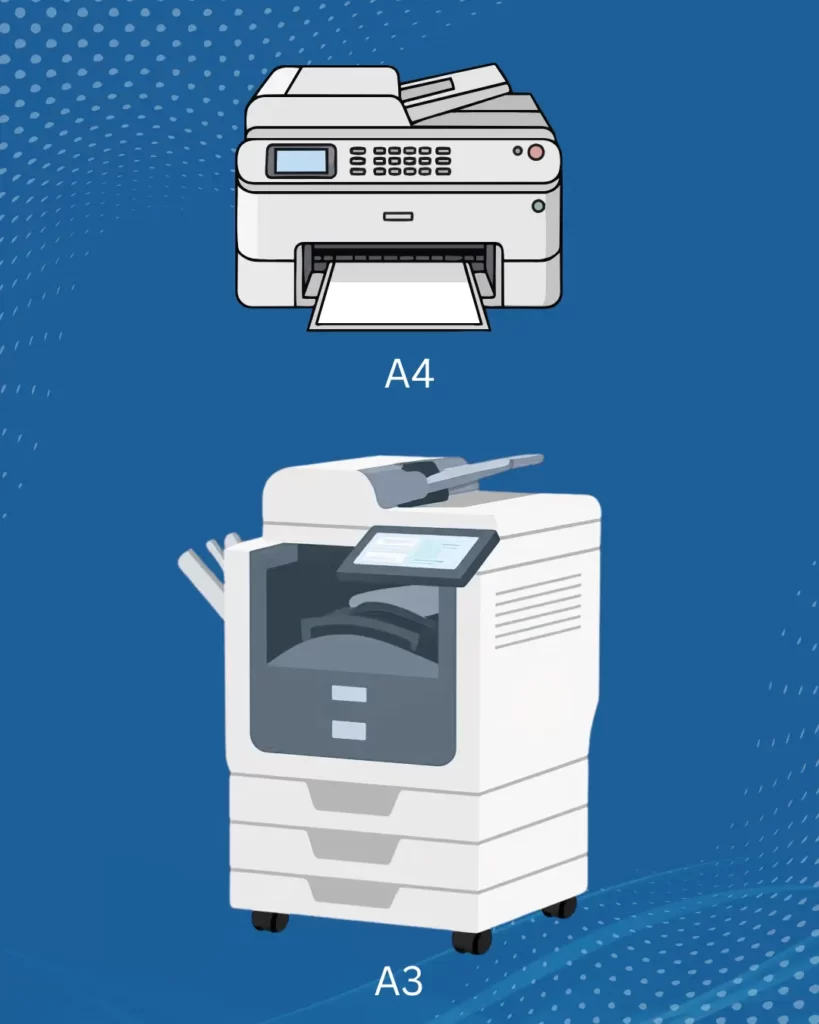
When businesses start looking for a new printer, one question pops up pretty quickly: A4 or A3?
At first glance, it seems like it’s just about paper size. But once you dig a little deeper, the choice actually affects how your team works, how much space your office needs, and even how much you spend on printing long-term.
If you’re trying to decide between an A4 printer and an A3 printer, here’s the real-world breakdown based on how businesses actually use them.
First Things First — What’s the Difference?
The difference is simple in theory.
An A4 printer prints standard office paper. Think everyday documents like invoices, reports, emails, and contracts.
An A3 printer, on the other hand, can print both A4 and larger A3 documents. That means things like spreadsheets, plans, marketing materials, posters, and presentations suddenly become easier to print without shrinking everything down.
So yes, it’s about size — but the capability difference is bigger than it sounds.
Why Many Small Offices Go for A4 Printers
A4 printers are popular for a reason. They’re compact, affordable, and perfect for businesses that mostly deal with standard paperwork.
If your office mainly prints documents, invoices, and occasional reports, an A4 printer usually does the job without taking up much space. For smaller teams or home offices, this setup just makes sense.
Another big advantage is footprint. A4 printers fit neatly on desks or small cabinets, which matters when office space is limited.
Where A3 Printers Start to Make More Sense
Once your business starts printing more than basic documents, A3 printers suddenly become the MVP.
Design teams, architects, construction companies, marketing departments, and schools often need bigger formats. Spreadsheets become easier to read, plans don’t need to be split across pages, and marketing materials can actually look the way they’re supposed to.
The bonus? A3 printers still handle A4 printing just fine. So they’re essentially two printers in one.
The Space and Budget Reality
Here’s the honest part people don’t always mention.
A3 printers are bigger machines. They’re designed for shared office use and usually handle higher print volumes. That means they take up more space and often cost more upfront.
But for businesses that print a lot, they can actually be more efficient in the long run. Faster speeds, higher capacity trays, and advanced finishing options (like stapling or booklet making) make them built for heavier workloads.
So Which One Should Your Business Choose?
If your business prints mostly standard documents and space is tight, an A4 printer will probably do the job perfectly.
But if your office handles larger documents, design work, plans, or higher printing volumes, an A3 printer offers a lot more flexibility.
The best choice really comes down to how your team works and what you print most often.